
Departmental Courses
Physics concepts and methods associated with musical instruments, musical recording, and musical acoustics are discussed at an introductory level. Topics include periodic motion, normal modes and resonance, superposition and Fourier series, waves, sound and acoustics, magnetism and electromagnetic induction, and topics from non-linear physics. Course is also offered online on demand in spring and summer semesters.
- Credits: 3.0
- Lec-Rec-Lab: (3-0-0)
- Semesters Offered: Fall, Spring, Summer
- Pre-Requisite(s): MA 1031(C) or MA 1032(C) or MA 1120(C)
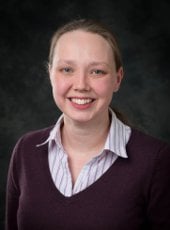
Katrina Black
- Associate Teaching Professor, Physics
- keblack@mtu.edu
- 906-487-2352
- Fisher 114
A companion hands-on lab course covering topics from PH1090.
- Credits: 1.0
- Lec-Rec-Lab: (0-0-2)
- Semesters Offered: Fall, Summer
- Pre-Requisite(s): PH 1090(C)
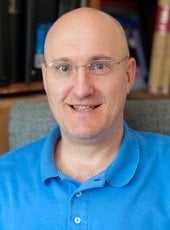
Wil Slough
- Director of First-Year Programs
- wjslough@mtu.edu
- 906-487-2273
- Fisher 221
Experiments covering kinematics, force, conservation of momentum, conservation of energy, and waves are explored through guided construction. The course emphasizes understanding physical concepts through inquiry and the scientific method
- Credits: 1.0
- Lec-Rec-Lab: (0-0-2)
- Semesters Offered: Fall, Spring, Summer
- Pre-Requisite(s): MA 1160(C) or MA 1161(C) or MA 1121(C)
Katrina Black
- Associate Teaching Professor, Physics
- keblack@mtu.edu
- 906-487-2352
- Fisher 114
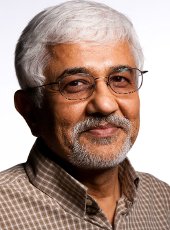
Ravindra Pandey
- Interim Dean, College of Sciences and Arts
- Professor and Department Chair, Physics
- Fellow of American Physical Society
- pandey@mtu.edu
- 906-487-2086
- Fisher 108
An overview of basic principles of kinematics, dynamics, elasticity, fluids, heat, thermodynamics, mechanical waves, and interference and diffraction of mechanical waves.
- Credits: 3.0
- Lec-Rec-Lab: (3-0-0)
- Semesters Offered: Fall, Summer
- Restrictions: May not be enrolled in one of the following College(s): College of Engineering; May not be enrolled in one of the following Major(s): Physics, Construction Management, Surveying Engineering, Electrical Eng Tech, General Technology, Mechanical Engineering Tech, Applied Physics, Computer Network & System Admn
- Co-Requisite(s): PH 1111
- Pre-Requisite(s): MA 1031 or MA 1032 or MA 1120 or MA 1135(C) or MA 1160(C) or MA 1161(C) or MA 1121(C) or ALEKS Math Placement >= 76 or CEEB Calculus AB >= 2 or CEEB Calculus BC >= 2 or CEEB Calculus AB Subscore >= 2 or ACT Mathematics >= 26 or SAT MATH SECTION SCORE-M16 >= 610
Katrina Black
- Associate Teaching Professor, Physics
- keblack@mtu.edu
- 906-487-2352
- Fisher 114
Michael Meyer
- Teaching Professor
- mrmeyer@mtu.edu
- 906-487-1708
- Fisher 111
Experiments covering kinematics, forces, conservation of momentum and energy, waves, and thermodynamics are explored through guided construction. The course provides inquiry-based laboratory experiences for concepts explored in PH1110.
- Credits: 1.0
- Lec-Rec-Lab: (0-0-2)
- Semesters Offered: Fall, Summer
- Restrictions: May not be enrolled in one of the following College(s): College of Engineering; May not be enrolled in one of the following Major(s): Physics, Construction Management, Surveying Engineering, Electrical Eng Tech, General Technology, Mechanical Engineering Tech, Applied Physics, Computer Network & System Admn
- Co-Requisite(s): PH 1110
Katrina Black
- Associate Teaching Professor, Physics
- keblack@mtu.edu
- 906-487-2352
- Fisher 114
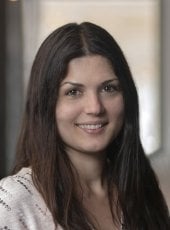
Elena Giusarma
- Assistant Professor, Physics
- egiusarm@mtu.edu
- Fisher Hall 111
An algebra-based introduction to classical mechanics and its applications. Topics include kinematics, Newton's laws, impulse and momentum, work and energy, simple harmonic motion, mechanical waves and sound, and temperature and heat.
- Credits: 3.0
- Lec-Rec-Lab: (3-0-0)
- Semesters Offered: Spring
- Restrictions: Must be enrolled in one of the following Major(s): Theatre & Entertain Tech (BS), Mechanical Engineering Tech, Computer Network & System Admn, Electrical Eng Tech, General Technology, Mechatronics, Construction Management
- Co-Requisite(s): PH 1141
- Pre-Requisite(s): MA 1031 or MA 1032 or MA 1120 or MA 1160(C) or MA 1161(C) or MA 1121(C) or MA 2160(C) and (PH 1100 or PH 1111 or PH 1141(C) or PH 1161)
Nathan Black
- Instructor
- Department Website/Social Media
- ndblack@mtu.edu
- Fisher 124B
Experiments covering kinematics, forces, conservation of momentum and energy, waves, and thermodynamics are explored through guided construction. The course provides inquiry-based laboratory experiences for concepts explored in PH1140.
- Credits: 1.0
- Lec-Rec-Lab: (0-0-2)
- Semesters Offered: Spring
- Restrictions: Must be enrolled in one of the following Major(s): Theatre & Entertain Tech (BS), Mechanical Engineering Tech, Construction Management, Computer Network & System Admn, Electrical Eng Tech, Mechatronics, Engineering Technology
- Co-Requisite(s): PH 1140
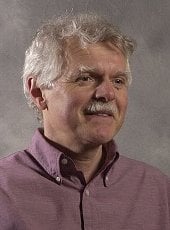
Jacek Borysow
- Interim Department Chair, Physics
- Professor, Physics
- jborysow@mtu.edu
- 906-370-5715
- Fisher 103
Calculus-based introduction to classical mechanics. Topics include mathematical concepts, kinematics, Newton's laws, the gravitational force, work and energy, and collisions. Also introduces departmental facilities, research within the department, and professional opportunities in physics. Intended for physics majors; highly motivated students seeking an invigorating introduction to physics may enroll with permission of the instructor.
- Credits: 4.0
- Lec-Rec-Lab: (4-0-0)
- Semesters Offered: Fall
- Restrictions: Must be enrolled in one of the following Major(s): Physics (BA), Physics, Applied Physics
- Co-Requisite(s): PH 1161
- Pre-Requisite(s): MA 1160(C) or MA 1161(C) or MA 1121(C) or MA 2160(C)
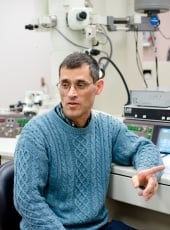
John Jaszczak
- Professor of Physics
- Director and John and Phyllis Seaman Endowed Curator, A. E. Seaman Mineral Museum
- Affiliated Professor, Materials Science and Engineering
- jaszczak@mtu.edu
- 906-487-2255
- Fisher 102 and A. E. Seaman Mineral Museum
A laboratory complement to PH1160. Experiments covering kinematics, force, conservation of momentum, conservation of energy, waves and thermodynamics are explored through guided construction. The course emphasizes understanding physical concepts through inquiry and the scientific method.
- Credits: 1.0
- Lec-Rec-Lab: (0-0-2)
- Semesters Offered: Fall
- Restrictions: Must be enrolled in one of the following Major(s): Physics (BA), Physics, Applied Physics
- Co-Requisite(s): PH 1160
Wil Slough
- Director of First-Year Programs
- wjslough@mtu.edu
- 906-487-2273
- Fisher 221
Experiments covering Coulomb's law, electric and magnetic fields, circuits, induction, and geometric optics are explored through guided construction. The course emphasizes understanding physical concepts through inquiry and the scientific method.
- Credits: 1.0
- Lec-Rec-Lab: (0-0-2)
- Semesters Offered: Fall, Spring, Summer
- Pre-Requisite(s): PH 1100 or PH 1111 or PH 1141 or PH 1161
John Jaszczak
- Professor of Physics
- Director and John and Phyllis Seaman Endowed Curator, A. E. Seaman Mineral Museum
- Affiliated Professor, Materials Science and Engineering
- jaszczak@mtu.edu
- 906-487-2255
- Fisher 102 and A. E. Seaman Mineral Museum
An overview of basic principles of static and dynamic electricity and magnetism, electromagnetic waves, reflection and refraction of light, interference and diffraction of light, special theory of relativity, wave theory of matter, particle theory of electromagnetic waves, theory of the atom, the nucleus, and elementary particles.
- Credits: 3.0
- Lec-Rec-Lab: (3-0-0)
- Semesters Offered: Spring, Summer
- Restrictions: May not be enrolled in one of the following College(s): College of Engineering; May not be enrolled in one of the following Major(s): Physics, Construction Management, Surveying Engineering, Electrical Eng Tech, General Technology, Mechanical Engineering Tech, Applied Physics, Computer Network & System Admn
- Pre-Requisite(s): PH 1200(C) and (PH 1110 or PH 1100)
Katrina Black
- Associate Teaching Professor, Physics
- keblack@mtu.edu
- 906-487-2352
- Fisher 114
Michael Meyer
- Teaching Professor
- mrmeyer@mtu.edu
- 906-487-1708
- Fisher 111
An overview of static and dynamic electricity and magnetism, electromagnetic waves, basic optics, and an introduction to modern and nuclear physics with an emphasis on problem solving and applications.
- Credits: 3.0
- Lec-Rec-Lab: (3-0-0)
- Semesters Offered: Fall
- Restrictions: Must be enrolled in one of the following Major(s): Computer Network & System Admn, Surveying Engineering, General Technology, Mechanical Engineering Tech, Construction Management, Electrical Eng Tech
- Co-Requisite(s): PH 1200
- Pre-Requisite(s): PH 1140 or PH 1110
Nathan Black
- Instructor
- Department Website/Social Media
- ndblack@mtu.edu
- Fisher 124B
Continuation of PH 1160. Topics include rotational motion, simple harmonic motion and mechanical waves. Offered first half of spring semester.
- Credits: 2.0
- Lec-Rec-Lab: (4-0-0)
- Semesters Offered: Spring
- Co-Requisite(s): PH 1361
- Pre-Requisite(s): (PH 1160 or PH 2100) and (MA 2160(C) or MA 3160(C))
Katrina Black
- Associate Teaching Professor, Physics
- keblack@mtu.edu
- 906-487-2352
- Fisher 114
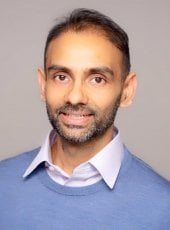
Kartik Iyer
- Assistant Professor, Physics
- Assistant Professor, Mechanical Engineering-Engineering Mechanics
- kiyer@mtu.edu
- 906-487-2356
- Fisher 109
Laboratory complement to PH 1360. Waves and thermodynamics are explored through guided construction. The course emphasizes understanding physical concepts through inquiry and the scientific method.
- Credits: 1.0
- Lec-Rec-Lab: (0-0-2)
- Semesters Offered: Spring
- Co-Requisite(s): PH 1360
Katrina Black
- Associate Teaching Professor, Physics
- keblack@mtu.edu
- 906-487-2352
- Fisher 114
Kartik Iyer
- Assistant Professor, Physics
- Assistant Professor, Mechanical Engineering-Engineering Mechanics
- kiyer@mtu.edu
- 906-487-2356
- Fisher 109
Introduces fundamentals of astronomy. Topics include Kepler's and Newton's laws of motion, origin and evolution of the solar system, galactic astronomy, extra-galactic astronomy, cosmology, and modern instrumentation, including space-based astronomy.
- Credits: 2.0
- Lec-Rec-Lab: (2-0-0)
- Semesters Offered: Fall, Spring, Summer
Katrina Black
- Associate Teaching Professor, Physics
- keblack@mtu.edu
- 906-487-2352
- Fisher 114

Mauricio Hurtado
- Assistant Teaching Professor
- mrhurtad@mtu.edu
- Fisher 121
Demonstrates fundamentals of astronomy using non-telescopic and telescopic observations, and computer simulations. Topics include angular size measurements, season-dependent measurements, phases of the moon, phases and orbits of planets, brightness of stars, introduction to the use of MTU's Observatory, instrumentation, and applications of computer programs involving cosmology.
- Credits: 1.0
- Lec-Rec-Lab: (0-0-2)
- Semesters Offered: Fall, Spring, Summer
- Co-Requisite(s): PH 1600
Katrina Black
- Associate Teaching Professor, Physics
- keblack@mtu.edu
- 906-487-2352
- Fisher 114
Wil Slough
- Director of First-Year Programs
- wjslough@mtu.edu
- 906-487-2273
- Fisher 221
A calculus-based introduction to classical mechanics. Topics include kinematics, Newton's laws, impulse and momentum, work and energy, and the universal law of gravitation. C or better/AP credit in Calc 1 or co-requisite registration in PH2110 required.
- Credits: 3.0
- Lec-Rec-Lab: (3-0-0)
- Semesters Offered: Fall, Spring, Summer
- Pre-Requisite(s): PH 1100(C) and (MA 1160 or MA 1161 or MA 1121 or MA 1135) and PH 2110(C) or (CEEB Calculus AB >= 3 or CEEB Calculus BC >= 3 or CEEB Calculus AB Subscore >= 3 and MA 2160(C) or MA 3160(C))
Michael Meyer
- Teaching Professor
- mrmeyer@mtu.edu
- 906-487-1708
- Fisher 111
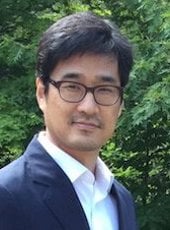
Jae Suh
- Associate Professor, Physics
- jsuh@mtu.edu
- 906-487-2272
- Fisher 113
A calculus-based introduction to electromagnetism. Topics include Coulomb's law, electric fields, Gauss's law, electric potential, capacitance, circuits, magnetic forces and fields, Ampere's law, induction, Maxwell's equations, and electromagnetic waves.
- Credits: 3.0
- Lec-Rec-Lab: (3-0-0)
- Semesters Offered: Fall, Spring, Summer
- Pre-Requisite(s): (PH 1200(C) or PH 2261(C)) and (PH 2100 or PH 1160) and MA 2160
Katrina Black
- Associate Teaching Professor, Physics
- keblack@mtu.edu
- 906-487-2352
- Fisher 114
Jacek Borysow
- Interim Department Chair, Physics
- Professor, Physics
- jborysow@mtu.edu
- 906-370-5715
- Fisher 103
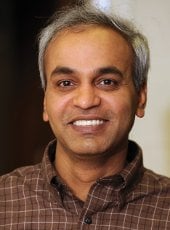
Ranjit Pati
- Graduate Director of Physics
- Professor, Physics
- patir@mtu.edu
- 906-487-3193
- Fisher 218
An introduction to analog and digital electronics with an emphasis on their use in the laboratory. Topics include linear devices and basic linear circuit analysis; diodes; transistors; op-amps; the use of digital components, including logic gates, flip-flops, counters, clocks and microcontrollers, and analog to digital conversions.
- Credits: 4.0
- Lec-Rec-Lab: (3-0-3)
- Semesters Offered: Spring
- Restrictions: May not be enrolled in one of the following Major(s): Electrical Engineering, Computer Engineering
- Pre-Requisite(s): PH 2200 or PH 2260
Jae Suh
- Associate Professor, Physics
- jsuh@mtu.edu
- 906-487-2272
- Fisher 113
Calculus-based introduction to electromagnetism. Topics include Coulomb's law, electric fields, Gauss's law, electric potential, capacitance, circuits, magnetic forces and fields, Ampere's law, induction, Maxwell's equations, electromagnetic waves and geometrical optics.
- Credits: 4.0
- Lec-Rec-Lab: (4-0-0)
- Semesters Offered: Fall
- Pre-Requisite(s): (PH 1160 or PH 2100) and (PH 1200(C) or PH 2261(C)) and MA 2160
Katrina Black
- Associate Teaching Professor, Physics
- keblack@mtu.edu
- 906-487-2352
- Fisher 114
A laboratory complement to PH2260. Experiments covering Coulomb's law, electric and magnetic fields, circuits, induction, geometric optics, and modern physics are explored through guided construction. The course emphasizes understanding physical concepts through inquiry and the scientific method.
- Credits: 1.0
- Lec-Rec-Lab: (0-0-2)
- Semesters Offered: Fall
- Co-Requisite(s): PH 2260
- Pre-Requisite(s): PH 1100 or PH 1161
Katrina Black
- Associate Teaching Professor, Physics
- keblack@mtu.edu
- 906-487-2352
- Fisher 114
A calculus-based introduction to fluids and thermal physics. Topics include fluid motion, propagation of heat and sound, temperature and the kinetic theory of gases, heat capacity and latent heat, first law of thermodynamics, heat engines and the second law, entropy, and an introduction to statistical mechanics. Offered second half of spring semester.
- Credits: 2.0
- Lec-Rec-Lab: (4-0-0)
- Semesters Offered: Spring
- Pre-Requisite(s): PH 1160 or PH 2100
Katrina Black
- Associate Teaching Professor, Physics
- keblack@mtu.edu
- 906-487-2352
- Fisher 114

Claudio Mazzoleni
- Professor, Physics
- cmazzoleni@mtu.edu
- 906-487-1226
- Fisher 117
A calculus-based introduction to waves and modern physics. Topics include interference and diffraction, special relativity, photons and matter waves, the Bohr atom, wave mechanics, atomic physics, molecular and solid-state physics, and nuclear physics.
- Credits: 3.0
- Lec-Rec-Lab: (3-0-0)
- Semesters Offered: Fall, Spring, Summer
- Pre-Requisite(s): PH 2200 or PH 2260
Katrina Black
- Associate Teaching Professor, Physics
- keblack@mtu.edu
- 906-487-2352
- Fisher 114
Mauricio Hurtado
- Assistant Teaching Professor
- mrhurtad@mtu.edu
- Fisher 121
An intermediate study of mechanics, including the study of Newtonian mechanics of a single particle and multiple-particle systems, oscillations, motion in noninertial reference frames, gravitation and central-force motion, and Lagrangian mechanics.
- Credits: 3.0
- Lec-Rec-Lab: (3-0-0)
- Semesters Offered: Fall
- Pre-Requisite(s): (PH 2200 or PH 2260) and (MA 3520 or MA 3521 or MA 3530 or MA 3560)
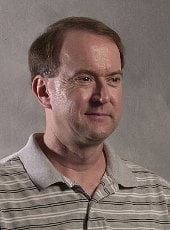
Robert Weidman
- Associate Professor, Physics
- weidman@mtu.edu
- 906-487-2126
- Fisher 106
A continuation of PH3110. Includes the study of the rigid body motion, relativistic mechanics, and coupled oscillations. Additional topics may include chaos theory, Hamiltonian mechanics, and continuous systems.
- Credits: 3.0
- Lec-Rec-Lab: (3-0-0)
- Semesters Offered: Spring
- Pre-Requisite(s): PH 3110
Robert Weidman
- Associate Professor, Physics
- weidman@mtu.edu
- 906-487-2126
- Fisher 106
An introduction to geometrical and physical optics. Topics in geometrical optics include ray analysis of mirrors, lenses, prisms, and optical systems. Topics in physical optics include polarization, interference, interferometry, and diffraction. The laboratory explores optics through experiments in imaging, fiber optics, interferometry, diffraction, polarization, and laser beam propagation.
- Credits: 3.0
- Lec-Rec-Lab: (2-0-3)
- Semesters Offered: Fall
- Pre-Requisite(s): MA 3520(C) or MA 3521(C) or MA 3530(C) or MA 3560(C)
Claudio Mazzoleni
- Professor, Physics
- cmazzoleni@mtu.edu
- 906-487-1226
- Fisher 117
Thermodynamic systems, heat, work, laws of thermodynamics, formal mathematical relations, cycles, phase equilibrium, and multicomponent systems. Elementary kinetic theory. Introduction to microscopic view of entropy, ensemble theory, and applications of statistical mechanics.
- Credits: 3.0
- Lec-Rec-Lab: (3-0-0)
- Semesters Offered: Spring
- Pre-Requisite(s): PH 2300 or PH 1360
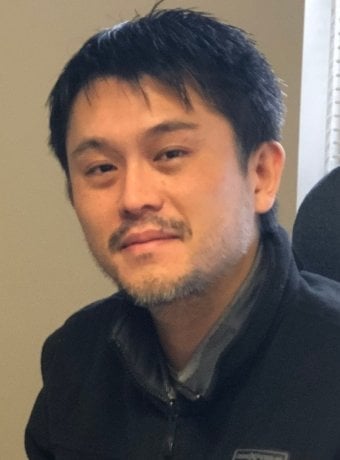
Issei Nakamura
- Associate Professor, Physics
- inakamur@mtu.edu
- 906-487-2019
- Fisher 110

Raymond Shaw
- University Professor, Physics
- Director, Atmospheric Sciences Ph.D. Program
- Affiliated Professor, Mechanical Engineering - Engineering Mechanics
- rashaw@mtu.edu
- 906-487-1961
- Office: Fisher 201G, Lab: Fisher 019B and Dow 105
Introduction to the techniques and methods frequently encountered in advanced physics with a particular emphasis on application to physical problems. Topics include, but are not limited to, complex numbers, vector analysis, partial differential equations, and integral transforms.
- Credits: 3.0
- Lec-Rec-Lab: (3-0-0)
- Semesters Offered: Fall
- Pre-Requisite(s): MA 3160 and (MA 3520 or MA 3521 or MA 3530 or MA 3560) and (PH 2200 or PH 2260)
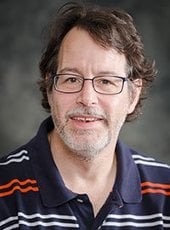
Robert Nemiroff
- University Professor
- Professor, Physics
- nemiroff@mtu.edu
- 906-487-2198
- Dow 303
An introduction to the foundations of modern physics and Schrodinger's wave mechanics. Topics include thermal radiation, particle-like properties of radiation, Bohr's model of the atom, matter waves, Schrodinger's wave mechanics, quantization of angular momentum, and the one-electron atom.
- Credits: 3.0
- Lec-Rec-Lab: (3-0-0)
- Semesters Offered: Spring
- Pre-Requisite(s): PH 2400 and (MA 3520 or MA 3521 or MA 3530 or MA 3560)
Robert Weidman
- Associate Professor, Physics
- weidman@mtu.edu
- 906-487-2126
- Fisher 106
A continuation of PH3410. Includes the study of spin and magnetic interactions, multi-electron atoms, quantum statistics, molecules, solids, and elementary particles.
- Credits: 3.0
- Lec-Rec-Lab: (3-0-0)
- Semesters Offered: Fall
- Pre-Requisite(s): PH 3410
Robert Weidman
- Associate Professor, Physics
- weidman@mtu.edu
- 906-487-2126
- Fisher 106
Through a series of experiments, students investigate physical phenomena that underlie modern physics. In the process, students become familiar with experimental techniques and instrumentation used in modern research laboratories.
- Credits: 2.0
- Lec-Rec-Lab: (0-0-6)
- Semesters Offered: Spring
- Pre-Requisite(s): PH 3210
Wil Slough
- Director of First-Year Programs
- wjslough@mtu.edu
- 906-487-2273
- Fisher 221
Class discussion of the literature in the field of physics. Requires oral and written presentations.
- Credits: 1.0
- Lec-Rec-Lab: (0-0-3)
- Semesters Offered: Fall
- Restrictions: May not be enrolled in one of the following Class(es): Freshman, Sophomore, Junior
- Co-Requisite(s): PH 4080
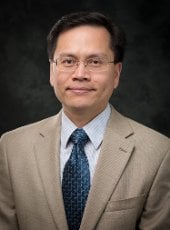
Yoke Khin Yap
- University Professor, Professor of Physics
- Affiliated Professor of Materials Science and Engineering, MTU Faculty Fellow
- Director of Applied Physics Graduate Program, Osaka University Global Alumni Fellow
- ykyap@mtu.edu
- 906-487-2900
- Office: Fisher 219, Labs: Fisher B013, B009, B031, B034
A continuation of PH4011. Class discussion of current literature and recent advances in physics. Requires oral and written presentations.
- Credits: 1.0
- Lec-Rec-Lab: (0-0-3)
- Semesters Offered: Spring
- Restrictions: May not be enrolled in one of the following Class(es): Freshman, Sophomore, Junior
- Co-Requisite(s): PH 4081
- Pre-Requisite(s): PH 4010
Yoke Khin Yap
- University Professor, Professor of Physics
- Affiliated Professor of Materials Science and Engineering, MTU Faculty Fellow
- Director of Applied Physics Graduate Program, Osaka University Global Alumni Fellow
- ykyap@mtu.edu
- 906-487-2900
- Office: Fisher 219, Labs: Fisher B013, B009, B031, B034
General methods and approaches of the physicist, including modeling, scaling, numerical estimation, and dimensional analysis as applied to the development, understanding, and solution of physics problems. Serves as an excellent preparation for students taking the GRE Subject Test in physics.
- Credits: 1.0; Graded Pass/Fail Only
- Lec-Rec-Lab: (0-1-0)
- Semesters Offered: Fall
- Restrictions: Must be enrolled in one of the following Major(s): Physics, Applied Physics; May not be enrolled in one of the following Class(es): Freshman, Sophomore, Junior
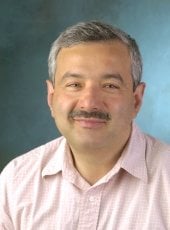
Alex Kostinski
- Professor, Physics
- kostinsk@mtu.edu
- 906-487-2580
- Fisher 104
Introduction to research under the guidance of a faculty member. In addition, creative problem solving will be assessed via a student-initiated project.
- Credits: 3.0
- Lec-Rec-Lab: (0-0-6)
- Semesters Offered: Fall
- Restrictions: May not be enrolled in one of the following Class(es): Freshman, Sophomore, Junior
- Co-Requisite(s): PH 4010
- Pre-Requisite(s): PH 3480
Yoke Khin Yap
- University Professor, Professor of Physics
- Affiliated Professor of Materials Science and Engineering, MTU Faculty Fellow
- Director of Applied Physics Graduate Program, Osaka University Global Alumni Fellow
- ykyap@mtu.edu
- 906-487-2900
- Office: Fisher 219, Labs: Fisher B013, B009, B031, B034
Continuation of research under the guidance of a faculty member, culminating in a written report and presentation of results at an undergraduate research forum.
- Credits: 3.0
- Lec-Rec-Lab: (0-0-6)
- Semesters Offered: Spring
- Restrictions: May not be enrolled in one of the following Class(es): Freshman, Sophomore, Junior
- Co-Requisite(s): PH 4011
- Pre-Requisite(s): PH 4080
Yoke Khin Yap
- University Professor, Professor of Physics
- Affiliated Professor of Materials Science and Engineering, MTU Faculty Fellow
- Director of Applied Physics Graduate Program, Osaka University Global Alumni Fellow
- ykyap@mtu.edu
- 906-487-2900
- Office: Fisher 219, Labs: Fisher B013, B009, B031, B034
Students prepare an in-depth written thesis on an approved topic in physics. Normally taken the last semester before graduation in conjunction with PH4081.
- Credits: 1.0
- Lec-Rec-Lab: (0-0-3)
- Semesters Offered: Spring
- Restrictions: Permission of instructor required; May not be enrolled in one of the following Class(es): Freshman, Sophomore, Junior
Yoke Khin Yap
- University Professor, Professor of Physics
- Affiliated Professor of Materials Science and Engineering, MTU Faculty Fellow
- Director of Applied Physics Graduate Program, Osaka University Global Alumni Fellow
- ykyap@mtu.edu
- 906-487-2900
- Office: Fisher 219, Labs: Fisher B013, B009, B031, B034
Intermediate study of the basic theory of electricity and magnetism, including a detailed study of electrostatic field theory and an introduction to magnetostatics.
- Credits: 3.0
- Lec-Rec-Lab: (3-0-0)
- Semesters Offered: Fall
- Pre-Requisite(s): (PH 2200 or PH 2260) and PH 3110 and (MA 3520 or MA 3521 or MA 3530 or MA 3560)
Petra Huentemeyer
- Director, Earth, Planetary, and Space Sciences Institute (EPSSI)
- Distinguished Professor, Physics
- petra@mtu.edu
- 906-487-1229
- DOW 307
A continuation of PH4210. Intermediate study of magnetostatics, electrodynamics, and electromagnetic waves.
- Credits: 3.0
- Lec-Rec-Lab: (3-0-0)
- Semesters Offered: Spring
- Pre-Requisite(s): PH 4210
Petra Huentemeyer
- Director, Earth, Planetary, and Space Sciences Institute (EPSSI)
- Distinguished Professor, Physics
- petra@mtu.edu
- 906-487-1229
- DOW 307
Material properties controlling light wave propagation in optical crystals and optical waveguides. Photonic crystals and photonic devices based on electrical, magnetic, and strain effects.
- Credits: 3.0
- Lec-Rec-Lab: (3-0-0)
- Semesters Offered: Fall
- Pre-Requisite(s): PH 2200(C)
Miguel Levy
- Professor, Physics and Materials Science and Engineering
- mlevy@mtu.edu
- 906-487-2084
- Fisher 115
An overview of numerical and computer methods to analyze and visualize physics problems in mechanics, electromagnetism, and quantum mechanics. Utility and potential pitfalls of these methods, basic concepts of programming, UNIX computing environment, system libraries and computer graphics are included.
- Credits: 3.0
- Lec-Rec-Lab: (2-0-3)
- Semesters Offered: Fall
- Pre-Requisite(s): PH 2020 and PH 3410
Issei Nakamura
- Associate Professor, Physics
- inakamur@mtu.edu
- 906-487-2019
- Fisher 110
Role of computer simulation in physics with emphasis on methodologies, data and error analysis, approximations, and potential pitfalls. Methodologies may include Monte Carlo simulation, molecular dynamics, and first-principles calculations for materials, astrophysics simulation, and biophysics simulations.
- Credits: 3.0
- Lec-Rec-Lab: (2-0-3)
- Semesters Offered: Spring, in odd years
- Pre-Requisite(s): PH 3300 and PH 4390 and (PH 2400 or PH 3410)
Elena Giusarma
- Assistant Professor, Physics
- egiusarm@mtu.edu
- Fisher Hall 111
Crystal structures, X-ray diffraction, phonons, free electron theory of metals, rudiments of band theory, an overview of semiconductors, and other topics in solid-state physics.
- Credits: 3.0
- Lec-Rec-Lab: (3-0-0)
- Semesters Offered: Fall
- Pre-Requisite(s): (PH 2300 or PH 1360) and PH 2400 and (CH 1150 and CH 1151) and (MA 3520 or MA 3521 or MA 3530 or MA 3560)
Ranjit Pati
- Graduate Director of Physics
- Professor, Physics
- patir@mtu.edu
- 906-487-3193
- Fisher 218
Topics include an overview of observational astrophysics, stellar atmospheres, stellar structure, atomic properties of matter, radiation and energy transport in stellar interiors, and stellar evolution to and from the main sequence. Course offered every third year beginning 2008-09.
- Credits: 3.0
- Lec-Rec-Lab: (3-0-0)
- Semesters Offered: Spring, in even years
- Pre-Requisite(s): PH 1600 and PH 2400 and (MA 3520 or MA 3521 or MA 3530 or MA 3560)
Elena Giusarma
- Assistant Professor, Physics
- egiusarm@mtu.edu
- Fisher Hall 111
Hands-on exploration of physics education methods in classroom, laboratory, and tutoring environments. Students study highlights of physics education research and explore use of several tools and pedagogical techniques, including web-based homework systems, simulations, classroom feedback systems, and equipment for laboratories and lecture demonstrations.
- Credits: 3.0
- Lec-Rec-Lab: (0-2-2)
- Semesters Offered: Spring, in even years
- Restrictions: May not be enrolled in one of the following Class(es): Freshman
- Pre-Requisite(s): PH 1210 or PH 2200 or PH 2260
Katrina Black
- Associate Teaching Professor, Physics
- keblack@mtu.edu
- 906-487-2352
- Fisher 114
Selected additional topics in physics for advanced students based on interests of faculty and students. Interested students should contact the physics department.
- Credits: variable to 9.0; May be repeated
- Semesters Offered: Fall, Spring, Summer
Yoke Khin Yap
- University Professor, Professor of Physics
- Affiliated Professor of Materials Science and Engineering, MTU Faculty Fellow
- Director of Applied Physics Graduate Program, Osaka University Global Alumni Fellow
- ykyap@mtu.edu
- 906-487-2900
- Office: Fisher 219, Labs: Fisher B013, B009, B031, B034